
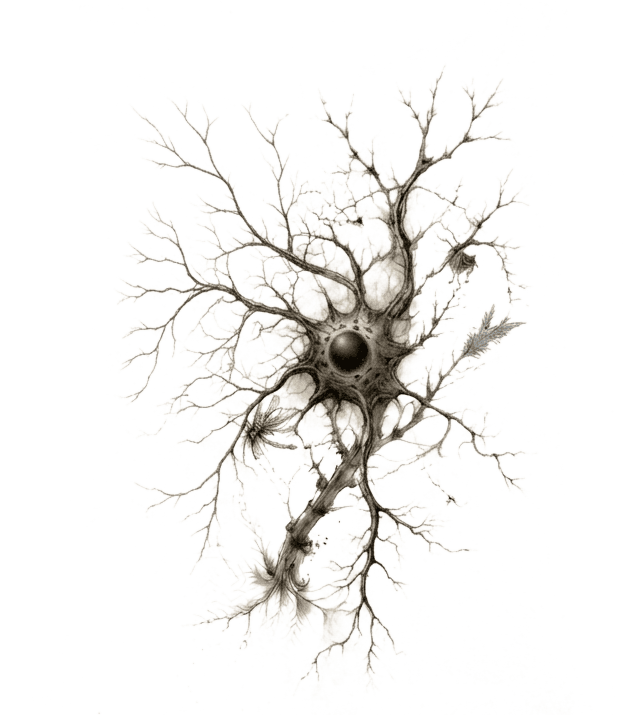
Identity is not sameness.
This is easy to say and hard to believe.
We often speak as if a thing remains itself by preserving its parts. The same file. The same database. The same name. The same public interface. The same team. The same purpose.
But living systems do not remain themselves by staying unchanged. They remain themselves by maintaining a continuity that can survive change.
The body replaces its cells.
A language replaces words.
A city replaces buildings.
An organization replaces people.
A software system replaces code, screens, data structures, services, deployment machinery, dependencies, and sometimes even its own explanation of what it does.
And still, something may remain.
The hard question is what.
A name gives a system a surface.
It lets people point.
"This is BookOps." "This is the checkout service." "This is the importer." "This is the graph." A name gathers code, behavior, data, memory, expectations, and responsibility into something that can be discussed.
But a name is not identity.
A name can survive after the thing it named has changed beyond recognition. A team can keep saying "the importer" while the old importer has become a family of workflows, adapters, retries, asset pipelines, and database synchronization rules. The name remains useful, but it may begin to hide the real structure.
Names are necessary because systems are too large to hold all at once.
Names are dangerous because they make old boundaries feel natural.
When a system evolves, its names must be tested.
Does the name still point to one thing?
Does it point to a role?
Does it point to a history?
Does it point to an illusion that used to be true?
Architecture is partly the discipline of letting names be corrected by reality.
A system is not only what it can do now.
It is also what it remembers.
Some memory is explicit: data, logs, migrations, events, tests, documentation, tickets, decisions, comments, diagrams, metrics.
Some memory is implicit: conventions, habits, workarounds, fears, shortcuts, stories, "we tried that once", "never touch this file", "this customer depends on that behavior", "this field looks unused but it matters".
Implicit memory is powerful because it can preserve knowledge that has not yet found a formal place.
It is also fragile.
When implicit memory lives only in people, the system can lose part of itself without any code changing. A person leaves. A habit is forgotten. A warning loses its context. A strange branch becomes normal. A workaround becomes doctrine.
The code still runs.
But the system has less identity than before.
It can no longer explain why it is shaped the way it is.
If identity is not sameness, then it must depend on something more selective.
One word for this is invariant.
An invariant is something that remains true while other things change.
In software, invariants can be technical: an order must have one owner, a content node must belong to one book, a permission check must happen before a mutation, a published URL must continue resolving.
But the most important invariants are often conceptual.
What must remain true for this system to still be this system?
For a reader, perhaps the invariant is that content remains addressable and discussable.
For a workflow system, perhaps the invariant is that work can be resumed after interruption.
For a library, perhaps the invariant is that ideas can move without losing their provenance.
For an architecture, perhaps the invariant is that new concepts can be added without collapsing the old ones.
These invariants are not always written down.
Sometimes they are discovered only when a proposed change violates them.
The discomfort is information.
Continuity is not the same as compatibility.
Compatibility asks whether old things still work.
Continuity asks whether the system can still be understood as the same evolving thing.
A change can be compatible and still break continuity. It may preserve the public API while destroying the internal language that made the system coherent.
A change can break compatibility and still preserve continuity. It may require migration, retraining, or a new interface, but it may bring the system closer to what it has been trying to become.
This is why version numbers are not enough.
They record sequence, not meaning.
A version can say that something came after something else. It cannot say whether the later thing has honored, betrayed, clarified, or outgrown the earlier thing.
Continuity is a narrative property. The system remains itself when its changes can be told as a history rather than a series of accidents.
Identity needs boundaries.
Without boundaries, nothing can remain itself because nothing is distinct enough to be changed. If every part of a system knows every other part, then no part can evolve without dragging the whole with it.
But boundaries must also move.
A boundary that never moves becomes denial. It insists that the old categories are still adequate even when reality has outgrown them.
A boundary that moves too easily becomes confusion. It lets every pressure redefine the system before the system has understood what the pressure means.
Good boundaries preserve identity by making negotiation possible.
They say:
- This belongs here.
- This does not belong here.
- This does not belong here yet.
- This used to belong here, but the system has learned a better place for it.
It is tempting to avoid psychological language here.
Software does not have a self.
But systems do have something like a self-description.
They have an internal account of what they are, what they protect, what they expose, what they remember, what they ignore, and what kinds of change they know how to survive.
This self-description may be:
- Formal, as in schemas and protocols.
- Social, as in team practices and institutional memory.
- Operational, as in runbooks, alerts, dashboards, and deployment rituals.
- Architectural, as in boundaries, dependencies, and allowed directions of flow.
- Narrative, as in the story a team tells when someone asks why the system exists.
A healthy system does not need all of these to be perfect.
It does need them to be able to correct each other.
When the story says one thing and the code says another, the system is divided.
When the schema says one thing and the workflow says another, the system is divided.
When the team believes one thing and the data proves another, the system is divided.
Identity is not the absence of division. It is the capacity to work through division without splitting into unrelated fragments.
A system loses itself when it can no longer recognize its own changes.
This can happen through:
- Rigidity. The system refuses to adapt, so every new pressure becomes an external patch.
- Drift. The system accepts every change, but none of the changes are integrated into a clearer model.
- Amnesia. The system keeps its behavior but loses the reasons for the behavior.
- Mimicry. The system copies the shape of another system without sharing the forces that made that shape meaningful.
- Over-abstraction. The system generalizes too early and erases the concrete tensions that would have taught it what the abstraction needed to be.
This is why anti-patterns are rarely just bad shapes. Spaghetti coupling, duplicated workflows, overloaded concepts, and hidden shared state are often symptoms of a system trying to preserve itself after an abstraction or boundary has failed.
The danger is not change. The danger is change without metabolized memory.
If evolution asks how systems change, identity asks how they remain continuous.
The next problem is complexity.
Because once a system has memory, boundaries, names, invariants, and histories of change, it begins to contain more relations than any one person can hold at once.
Complexity is what happens when identity becomes distributed.